Ethereal EBS
A multi-tenant enterprise business suite with a real double-entry ledger underneath it and a cross-company wholesale market wired in.
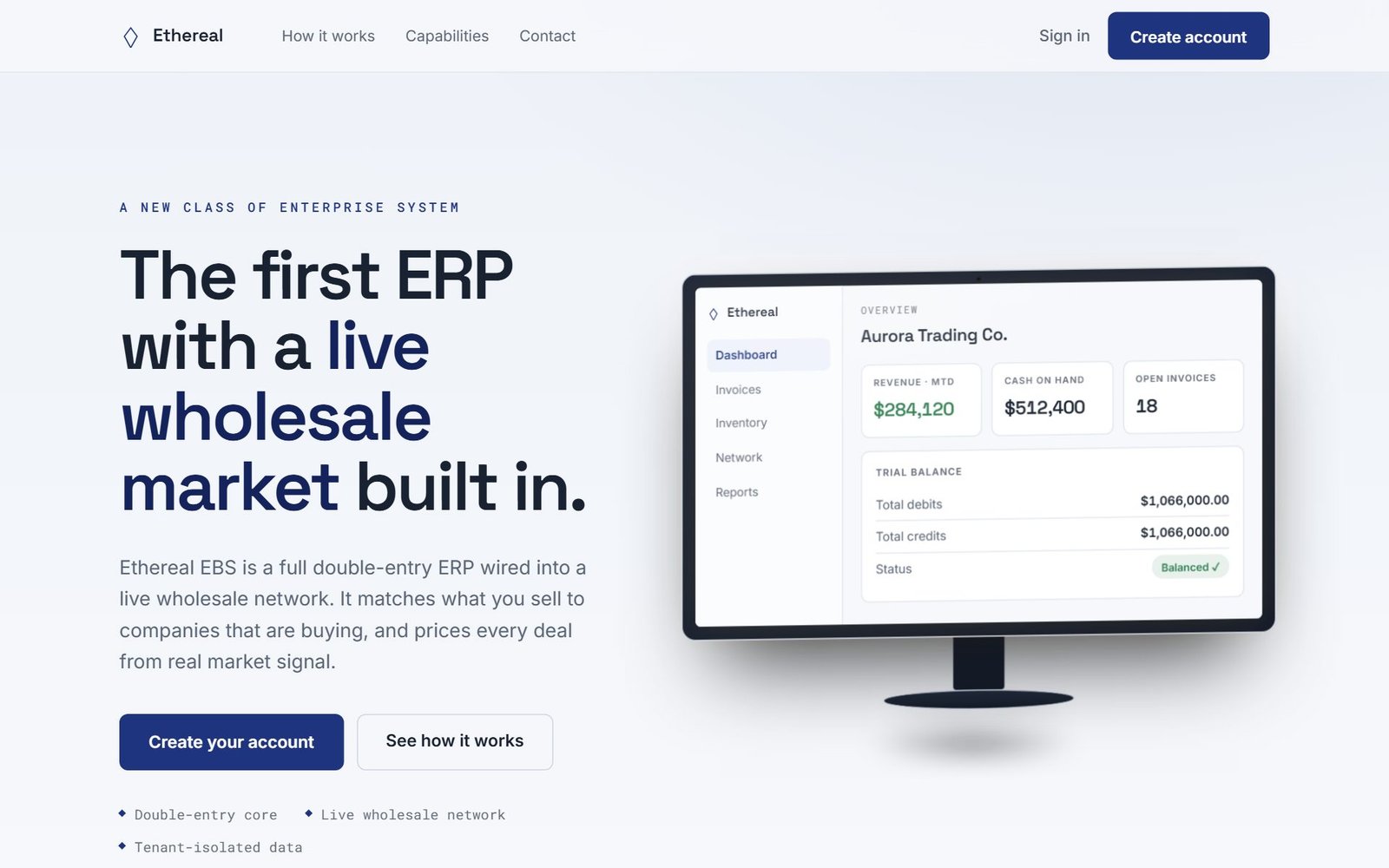
An enterprise business suite for companies that had outgrown a spreadsheet and a general-purpose CRM. An earlier codebase had accreted to the point where changing one part broke another, so the engines that were provably correct — ledger, receivables, payables, costing, tax, tenant isolation — were ported forward and everything around them was rebuilt clean.
The operational problemOperations were split across systems that disagreed with each other, and a spreadsheet settled the argument. Nothing enforced that the books balanced, and nothing stopped one company's records from being visible to another on shared infrastructure.
What was delivered- A platform kernel that treats tenancy as a primitive rather than a filter applied later: every repository call is scoped, and a cross-tenant read returns a 404 rather than a row.
- A double-entry general ledger that refuses an unbalanced journal, freezes a journal once posted, mirrors a reversal instead of editing history, and proves debits equal credits on the trial balance.
- Order-to-cash and procure-to-pay closed end to end: quotations, orders, invoices and receivables on one side; vendors, purchase orders, bills, debit memos and vendor returns on the other, all posting through the ledger.
- Eight working areas — dashboard, pipeline, purchase, accounting, sales team, marketing, reports and settings — with the first accounting report, the trial balance, tied out against a live posted invoice.
- A cross-tenant wholesale network: companies list what they are selling, express interest, and are matched, with staff-tier membership management deciding who can act on behalf of a company.
- Transactional email built against Postmark, queued to an outbox table until a sending domain is verified rather than dropped.
- nginx reverse proxy in front of the application, with rate limiting keyed on the real client address.
- SQLite via better-sqlite3 on Node 22, deployed to a single server the operator controls.
- 858 of 858 automated tests passing at the wholesale-network milestone, from 35 at the first domain wave and 477 at the trial-balance tie-out.
- A red-team pass specifically hunting cross-tenant leakage came back clean.
- The trial balance was tied out live against a real posted invoice rather than a fixture.
- A reversal-netting defect was caught by the build orchestration and fixed before it reached the ledger's users: a reversal now nets to zero on the trial balance.
- Outbound email has not been sent end to end. It is built and it queues, and it stays queued until a sending domain is verified.
- No public HTTPS cutover metrics exist yet; the go-live runbook for TLS and email is written but has not been executed against production volume.
Platform, backend and application engineering; deployment and operations.
No consulting engagement on this one — it was delivered by the engineering arm directly for the client.
What this engagement draws on.
SOPHIA XT is the engineering arm of 3 Point Forward.
3 Point Forward
3 Point Forward does the business work: diagnosing what is actually wrong with an operation, planning the implementation, applied-AI consulting, training the staff who will run it, and managing the engagement.
SOPHIA XT — the engineering arm
SOPHIA XT does the engineering: custom business software, integrations, AI engineering, developer tooling and the research underneath it.
One company, two jobs. 3 Point Forward defines the operational problem and the implementation plan; SOPHIA XT builds what the plan needs. A company that already knows what it wants built can go straight to SOPHIA XT, and a company that needs the problem defined first should start at 3 Point Forward. Either door reaches the same team.
Something like this, for your operation?
Start with the assessment if the problem is not pinned down yet, or book a consultation if it is.