Tophat
An enterprise business suite for a commercial real estate brokerage, with an assistant that answers from the brokerage's own rows and cites the record it read.
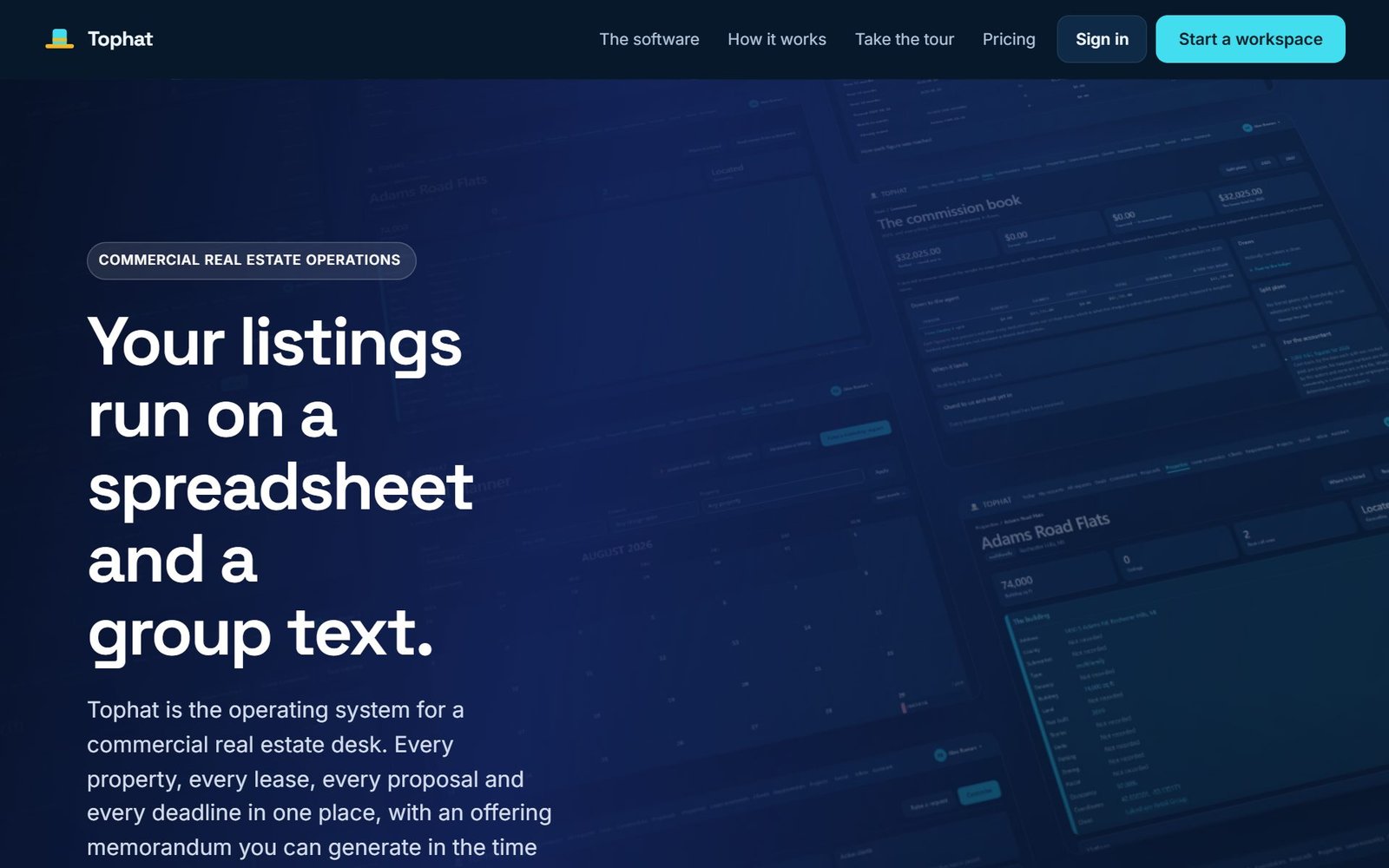
A commercial real estate investment brokerage running clients, properties, listings, projects and proposals across tools that did not talk to each other. The brokerage wanted the system on its own network rather than in somebody else's cloud, which set the architecture before anything else did.
The operational problemThree things the brokerage said it could not track at all, plus a listing workflow that depended on people remembering the order of operations. An exclusive listing agreement signed late would silently let the marketing plan run early, and nothing in the software objected.
What was delivered- Clients, properties, listings, projects, proposals and documents in one system, with a rent roll, comparables and the reporting over all of it.
- A request workflow that enforces order: a step that depends on the exclusive listing agreement refuses to be marked done by name until the agreement is done, and a step declaring a required link or file refuses to complete without one.
- An assistant in command mode that answers from live rows and returns the record identifier behind each claim, so an answer can be resolved back to the row or fail loudly as not found.
- A CSV importer that survives real-world files: encoding fallback for Windows-1252 with CRLF, a staged review that separates ready from warned from failed from duplicate, a single-transaction commit, and a refusal to commit the same job twice.
- An offline edge node that indexes its own corpus with no database in its require graph, so retrieval keeps working where the network does not.
- Valuation functions that return null on a missing input rather than a plausible zero.
- PostgreSQL 16 on the brokerage's own hardware. pgvector optional: without it retrieval runs lexical-only and the boot banner says so rather than pretending.
- Map tiles are the only external service the core product requires.
- Media handling refuses SVG by name and refuses a generated asset in a property-photo slot.
- The full request workflow was walked end to end against the live database: a request minted its identifier, copied nine checklist items from a template, added four watchers, and wrote thirteen events and fifty-two notifications across the walk.
- The out-of-order guard held: completing the listing step before the exclusive listing agreement was refused by name, and marking the agreement done unblocked it.
- Citation resolution was verified both ways — a real identifier resolves to its live row, a fabricated one returns not-found rather than a confident guess.
- Every page returns 200 for a signed-in staff account, redirects an anonymous visitor to the login gate, and returns 401 on a wrong password, verified over HTTPS.
- The tenancy check passes across every module.
- The assistant's tool-calling loop has never completed against a live model. The provider account returns an inactive-account error, which was probed directly rather than assumed. The integration is built against the real contract and the degradation path is exercised; the loop itself is not.
- Vision extraction and image generation are written against documented API shapes and are unexercised.
- The site-intelligence layer has schema, loaders and query code but no public dataset loaded behind it, so its geographic aggregates are untested.
- Retrieval is lexical-only on the current deployment, so a question phrased entirely in words absent from the stored records will miss. Installing the vector extension fixes it with no code change.
Product architecture, application engineering, the grounded assistant, and the on-premise deployment.
No consulting engagement on this one — it was delivered by the engineering arm directly for the client.
What this engagement draws on.
SOPHIA XT is the engineering arm of 3 Point Forward.
3 Point Forward
3 Point Forward does the business work: diagnosing what is actually wrong with an operation, planning the implementation, applied-AI consulting, training the staff who will run it, and managing the engagement.
SOPHIA XT — the engineering arm
SOPHIA XT does the engineering: custom business software, integrations, AI engineering, developer tooling and the research underneath it.
One company, two jobs. 3 Point Forward defines the operational problem and the implementation plan; SOPHIA XT builds what the plan needs. A company that already knows what it wants built can go straight to SOPHIA XT, and a company that needs the problem defined first should start at 3 Point Forward. Either door reaches the same team.
Something like this, for your operation?
Start with the assessment if the problem is not pinned down yet, or book a consultation if it is.